
Yes, there is such a thing as first harmonic distortion
More of a chatty blog post format, this one.

Wait a minute. Let’s see if I understand this. (Here I’m channeling you, the puzzled reader, after you’ve grabbed me in the coffee break of a Filter Wizard lecture morning). The frequency of the nth harmonic of a sinusoid is n times that of the fundamental. The nth harmonic distortion is defined as the ratio of the amplitude of the nth harmonic to the amplitude of the fundamental. So the 1st harmonic distortion is… the ratio of the amplitude of the fundamental to the amplitude of the fundamental and that’s… unity. I. Do. Not. Understand.
You’re sweating. People are starting to look, keep their distance maybe. Cognitive surrender is just around the corner. You need help.
-- and there’s a flash, the snap of freshly-pressed satin, and Equation Man is there! My trusty sidekick. He’s going to make it better. I step back, and let my algebraic alter ego take over. He picks up a cosine of angular frequency ω and…
… let’s assume we take our signal of x=v0cos(ωt) and apply a mild s-shaped compression of the form y = x – kx3 over the normalized range -1 ≤ x ≤ +1, with k small, because there’s not very much of this non-linearity. Because

we’ll have:

Now, you’re right about that definition of total harmonic distortion. The only extra frequency that has popped up is the 3rd harmonic, which forms all of the (conventionally defined) THD:
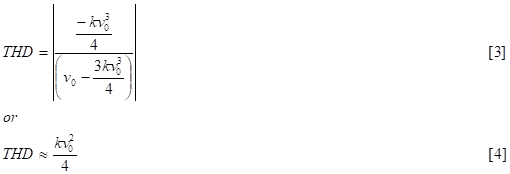
We can write down that simplification in [4] because the denominator term in [3] is pretty close to unity. That’s a clue… because the fundamental amplitude is slightly changed from v0cos(ωt) to:

Look at that. If the THD – which here is only the 3rd harmonic – is not zero, then the amplitude of the fundamental is not what it was before we applied the non-linearity. Depending on the sign of k (positive for compression, negative for expansion), it could be larger or smaller.
This is first harmonic distortion – the inevitable change in the amplitude of the fundamental caused by a gain non-linearity. And because the THD caused by this non-linearity is a function of signal level, so is the gain of your system at the fundamental frequency.
So, for example, in a system with 0.01% (-80dB) 3rd harmonic distortion at full scale, the absolute gain linearity error will be approximately 0.03%, compared to when measured at a much lower signal amplitude where the distortion is negligible.
If you need to calibrate the gain of your system very precisely, then it’s clearly a problem if the gain depends on the signal level!
Corresponding calculations can naturally be done for higher order non-linearities, with some simplifications. To briefly show the result for y = x – kx7 rather than the equation-rich workings:

where n is an RMS composite of the 3rd, 5th and 7th harmonics you get from this higher-order bendiness. We get:
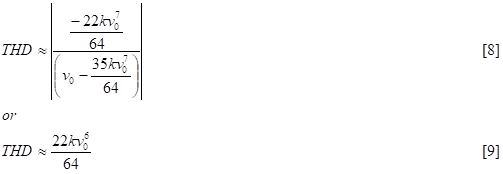
And that ends up giving us:

In other words (OK, other letters, numbers and symbols) only about half the linearity effect of the pure 3rd order non-linearity for the same amount of measured harmonic distortion. See “Accurate prediction of harmonic levels from non-linear gain expansions” in this Substack for the typical harmonic spectrum of this 7th order non-linearity.
We can also extend this approach (see “Accurate prediction… again) to non-linearities with a weak hyperbolic tangent form, the characteristic of the classic degenerated bipolar transistor differential pair which is typical of many high-speed analog circuits. Quite useful for all the amplifier designers out there.
As an interesting (well, it is to me) aside, note that if the non-linearity is present at the output of a circuit with feedback applied around dominant pole stabilization, then there will also be a phase non-linearity which, just conceivably, could have an effect in, for instance, power metrology applications should extremely low supply current analog techniques be used (op-amps which are too slow).
Well, there, Equation Man has done his bit, and you look, well, a little better. Another coffee and you’ll be fine. That afternoon lecture on elliptic function filters is going to fly by…
What’s the moral of this particular story? Mainly that an impairment in your system transfer function (e.g. non-linearity) may not just cause the errors that you’re expecting (e.g. harmonic distortion) but also errors that you weren’t expecting, and therefore don’t look for (e.g. variation of gain with signal level) until it’s too late.
In other words, don’t just look at the defects in your solution whose presence you can prove; look also for the defects whose absence you must ensure. Because that… is fundamental!